Randy Couture Interview: Military Background
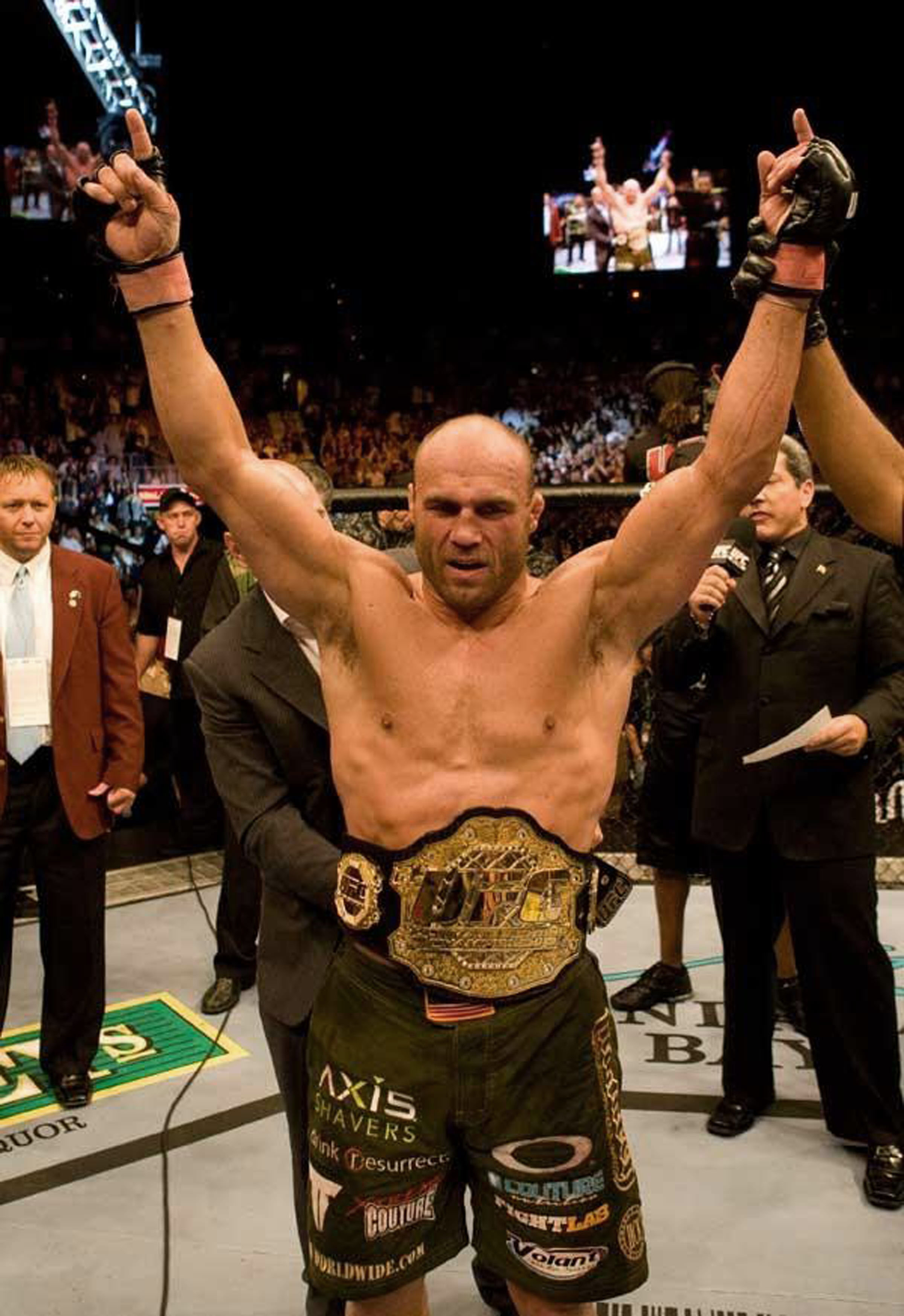
Randy Couture needs no introduction. He is a true pioneer of Mixed Martial Arts, the first-ever two-division UFC Champion and a decorated Army veteran. Not to mention a Hollywood movie star. “The Natural” was gracious with his time, and an excerpt of our conversation is transcribed below. It was an honor to interview a living legend.
GrapplerMag: What initially motivated you to join the Army at nineteen years old?
Randy Couture: I had a kid on the way. I had a family, a new blossoming family and I had to support that family. I wasn't going to be a deadbeat. The Army allowed me to support that family.
My daughter was born in Germany when I was stationed over there. When I went and took the ASVAB and signed up, my son Ryan, my oldest, was on the way. So that's ultimately what took me away from walking on at Washington State University trying to wrestle. I needed to support that family.
So, I joined the service and spent six years in the uniform. It was an amazing experience for me. Like I said, my daughter was born in Germany when I was stationed over there in my first duty station. That was a big decision for me actually to get out of the Army.
After six years chasing that Olympic dream, making the ‘88 Olympic team as an alternate, as a soldier. Then I started getting all these scholarship offers to go wrestle in college. And I was like, ‘Wow, I don't know. I'm kind of getting everything done here, chasing that Olympic dream and supporting my family at the same time. That's a big risk.’
But the Army coach was very encouraging and said, “Look, as much as I'd want to keep you here on the team, I think it's probably better for you to get out, go get that scholarship and take care of your family down the road.”
And he said, “You're crazy if you don't go to Oklahoma State.” I had a scholarship offer from Okie State, which is one of the best, best wrestling colleges in the country. So he encouraged me. And I made that decision and got out of the service in 1988 that August and drove from Fort Campbell, Kentucky over to Stillwater, Oklahoma to start my wrestling career at Oklahoma State.
GM: That's very admirable. I was really just hoping it wasn't a bad recruiter story. I was reluctant. I was a little afraid to bring it up.
RC: Actually, mine was a great recruiting story. I went in, took the ASVAB. I scored high. They're like, ‘Well, you know, they're giving $5,000 enlistment bonuses right now for air traffic controllers. You qualify. Do you want to do that?’ And I was interested in aviation. I wanted to fly helicopters, which was something that had always intrigued me.
And here now I'm considering joining the Army, that was an opportunity for me to maybe do that. So this recruiter did say, “Okay, well, we give ten spots to civilians and ninety spots to service members. You're going to have a way better shot at getting into flight school as a service member than you are as a civilian. And we'll give you this $5,000 enlistment bonus if you're an air traffic controller, which is in aviation. So that'll give you a leg up as well.”
So I joined, and I got that enlistment, and went to Fort Rucker, Alabama for air traffic control school.
GM: You were a Sergeant in the 101st Airborne, correct?
RC: When I got out, yes, my last duty station was Fort Campbell, Kentucky. I went to Air Assault School and PLDC there, and made my Sergeant rank while I was stationed at Fort Campbell.
GM: The Screaming Eagles, right?
[laughs]
RC: The Screaming Eagles, yep.
GM: If the story ended there, that would be badass just by itself. It's good to hear that you had a positive experience overall in the Army. Was there a particular aspect of the Armed Forces you enjoyed or excelled at?
RC: Well, I seem to take to the discipline and the order of it all like a duck to water. I was kind of that kid already, everything had its place. My room was immaculate, you know? I wasn't one of those sloppy kids. My buddies would come over for a sleepover and throw their shit on my floor and I'd be like, ‘Hey, that doesn't go there. What are you doing?’ So learning to fold my socks properly and my underwear properly didn't bother me at all.
GM: Respect the space. Was there something you weren't especially fond of?
RC: Honestly, from top to bottom, it was a great experience for me. It was very formative. I think after you've taken that oath and worn that uniform, you look at the world in a particular way and that never goes away. I have some of my best friends in life to this day from that experience in that time of my life. So I have not a single complaint.
I embraced the work. I think wrestling created that work ethic and that mindset in me at a very early age, started wrestling at ten, for all the wrong reasons, to get the attention of that dad that was never around. But I found the place I seemed to flourish, and the sport of wrestling certainly carried me down the road and kept me out of trouble.

Brandon Ibarra
Brandon attended the College of Journalism at the University of Florida. He has one stripe on his white belt.
Related Products